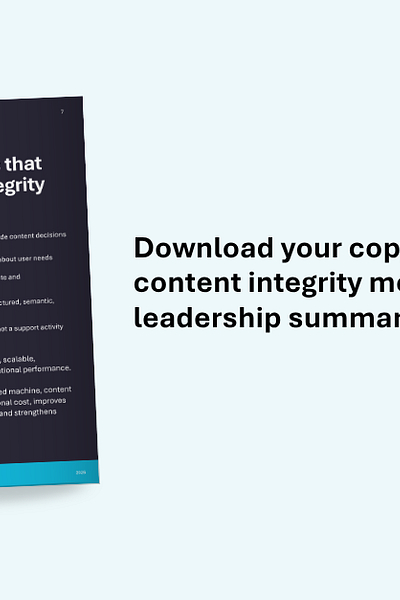
For leaders responsible for customer experience, growth, and operational efficiency, the Content Integrity Model offers a way to see content for what it has become: a strategic asset that influences adoption, conversion, satisfaction, and cost. The model plays out in day-to-day content work, but many of the decisions that determine whether content holds up are made well above the content team. These include which markets and languages to enter, which channels to support, which tooling to buy, and what gets funded.
As a companion to the Content Integrity Model ebook, this Leaders Summary condenses the model into what matters at a leadership level. It gives a brief overview of the four dimensions: Strategic, Editorial, Operational, and Infrastructure. It explains why weakness in any one of them limits the organisation’s ability to deliver consistent, high-quality experiences. It also sets out five actions leaders can take to enable content integrity:
Articulate clear strategic priorities that guide content decisions
Fund research to eliminate assumptions about user needs
Align teams on governance to reduce waste and inconsistency
Invest in infrastructure that supports structured, semantic, interoperable content
Treat content as part of the value chain, not a support activity
The summary also makes the business case in three points: scale multiplies complexity, investment must shift upstream, and infrastructure decisions have long-term impact. Tooling chosen for convenience today can become a structural constraint tomorrow.
If you’re a practitioner, this summary pairs with the Practitioner’s Guide. It’s designed to be shared with the people who set priorities and approve budgets. I’ve included the Leaders Summary as a free download from the Content Seriously site.
Content Integrity Leaders Summary Ebook