


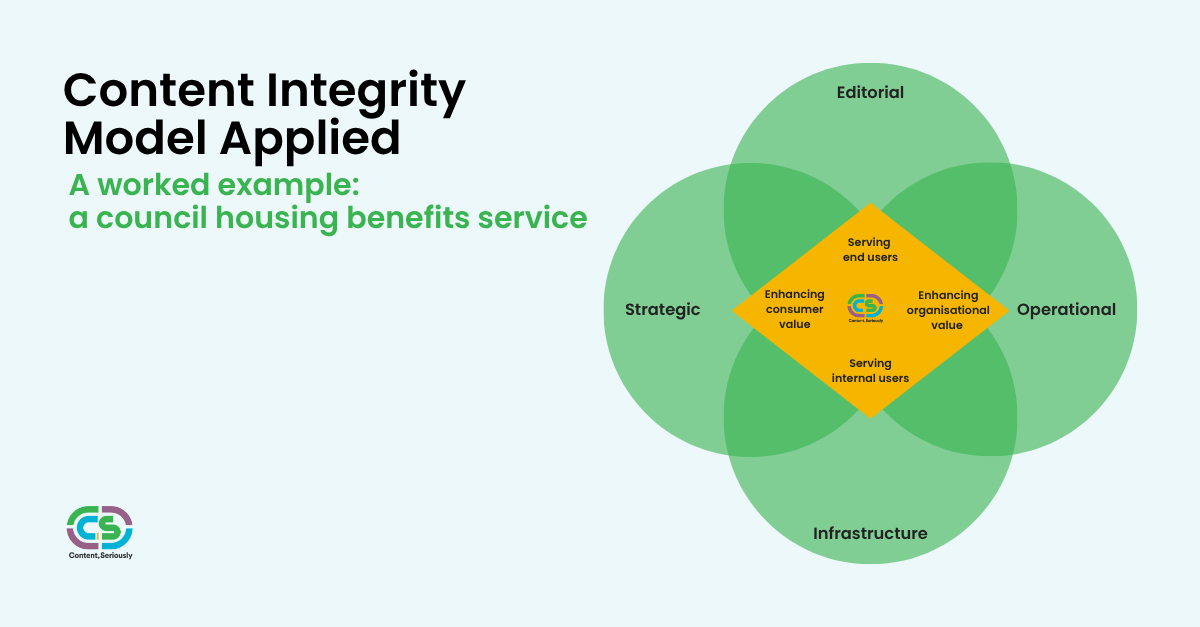
The Content Integrity Model is easy to understand in the abstract. The four dimensions need to work together, where strength in one dimension must be balanced with equal strengths in the other dimensions. However, the value of any model is in what it does when you put it to work against a real situation, with real constraints, real users, and real outcomes.
Let’s work through a theoretical example that public sector content teams will recognise immediately and, as residents of a local council, we can all relate to. It is detailed enough to show how the four dimensions interact, and ordinary enough that the lessons transfer to plenty of other contexts, in private and third sectors. A local government council launches a service that provides housing benefits to vulnerable people who meet the criteria to qualify for those benefits. To handle the volume and variety of enquiries the service will generate, the council wants to include an AI-enabled chatbot to handle resident enquiries.
Strategic integrity: content is produced for a reason
Organisations only produce content when there is a reason (and even then, they’re conservative with how much information they hand out). The content must provide some organisational value – it’s rare to see content that is enhanced for user comprehension when the organisation won’t also benefit. That may sound obvious, until you watch how often content gets made because a deadline arrived, a senior stakeholder panics and asks for a new page, or the existing information is having a knock-on effect elsewhere, as in lack of clarity generating support requests.
Strategic integrity means starting from the reason that content needs to be created. In the example of a council, the strategic objectives behind the service are specific: Handle resident enquiries about housing benefit in a sustainable way.
The strategy defines the *what* but not the *how* this gets done; that gets decided by the team designing the service: Ensure residents can determine their eligibility and understand the application process.
The strategy likely will not discuss the entire user journey, which would include stages such as setting up an account, tracking the status of an application, making an appeal, and so on: Enable residents to self-serve accurate information so that call centre volumes stay manageable.
The strategy specifies the outcome, but leaves the mechanism to those designing the service: Serve a resident population with varying levels of digital literacy and language needs.
The strategy defines the boundaries of the service, which the service designers can then enforce in an appropriate way.
These are organisational goals: reduce pressure on the call centre, support the whole applicant journey, reach a population that does not all read English at the same level or speak it as a first language. At times, the strategy may sometimes be expressed as “publish a housing benefits page” and it’s only through analysis by the content strategist that all of the nuance gets teased out.
The content that gets created is to reach those strategic goals. That is what strategic integrity looks like in practice: content decisions that trace directly back to what the organisation is trying to achieve.
The strategic dimension influences the editorial dimension because a better resident experience while still meeting the council’s objectives is an editorial brief. The strategy also influences the infrastructure dimension, because none of the self-serve, multi-channel, multi-language ambition is possible without a tech stack that supports it. Strategy that is thoughtful and explicit makes the other dimensions run more smoothly. Strategy that is vague forces every other team to compensate with workarounds.
One practical tool worth borrowing here is the change management impact graph (with thanks to Kate Kenyon for the framing): map the areas where content problems and business ambitions overlap most heavily. The greater the overlap, the easier the change is to justify and to land. For the council, the overlap is obvious: high call centre costs, a legal duty to communicate clearly, and a vulnerable audience all sit on top of the same content. That is where to start.
One overlap of the strategic and editorial dimensions that rarely gets discussed is content provenance. By that, I mean that the mechanism by which there is direct traceability from the strategy to the content produced. This gets discussed as part of operational efficiency: the ability to quickly identify content provenance.
Editorial integrity: quality is what serves the user
Editorial integrity means more than editorial quality. Quality is about providing accurate content to users. The integrity aspect means that content helps the user complete their task. It also means that the content complies with applicable regulations and guidelines.
For the council, editorial integrity means making sure the information serves the strategic objectives and is fit for use by both residents as well as the council. This includes:
Creating content that covers every aspect of the service, from setting up and closing an account, eligibility, how to apply, application status tracking, appeals, and so on.
Delivering consistent, up-to-date information that residents can act on at every stage of their journey.
Meet the council’s obligations under regulations applicable to the public sector, such as accessibility (e.g. dyslexia), plain language, GDPR, and so on.
Ensuring that content can be accessed by vulnerable residents with varying literacy and English-language skills.
Tagging information with enough metadata that makes it understandable by machines, for automated delivery to different audiences, and by AI models, reducing hallucinations.
Adding metadata, from basic things such as adding alt text on images to more sophisticated things like using knowledge graphs, is what traditional editorial work tends to skip, and now becomes mission-critical in an environment with lots of componentised content that is delivered through automated processing.
And then there’s the AI factor. Editorial responsibilities shift from creating content to more of a curation function, deduplicating content in the repository, ensuring consistency across the corpus, monitoring what the AI surfaces, and enriching content with the semantics that make it retrievable. An AI-enabled chatbot that can answer “am I eligible” but can’t answer “how do I appeal” is a fail. Consistency matters when an AI is reading the content, because contradictions between multiple pages become contradictions in the chatbot’s answers.
The decision to put an AI-enabled chatbot in front of residents asking about housing benefit is where the four dimensions of content integrity stop being a diagram and start being a system. A chatbot is only ever as good as the content it draws on. Point a chatbot at a pile of inconsistent, outdated, poorly structured pages and it will confidently give vulnerable people the wrong answer about services they may depend on.
When it comes to editorial integrity, this is where the regulatory responsibilities factor in. A non-exhaustive list of what content like this has to answer to in the UK:
Copyright, Designs and Patents Act 1988
Consumer Protection Act 1987
Consumer Rights Act 2015
Digital Markets, Competition and Consumers Act 2024
Equality Act 2010, together with the Public Sector Bodies (Websites and Mobile Applications) Accessibility Regulations 2018
General Product Safety Regulations 2005
Online Safety Act 2023
Plain Language Standard ISO 24495-1:2023
UK GDPR and the Data Protection Act 2018
Getting editorial integrity right is what keeps the council on the safe side of legal penalties, regulatory and compliance exposure, AI-related abuse, and the one that matters most for this audience, equal access to information. Vulnerable residents are precisely the people most harmed when content is inaccessible, inaccurate, or out of date.
The editorial dimension reaches in both directions. It influences the strategic dimension, because a better user experience that also meets business objectives is the strategy at play. The editorial aspect influences the operational dimension because the thing that makes automation possible at all is strong semantics (machine-readable metadata) that creates context. This is a move from thinking about copy to thinking about systems.
Here we come back to content provenance. This type of traceability used to be common in engineering environments, where all activity emanates from specifications. A specification leads to development of a feature, which then leads to the documentation of that feature. Codes are assigned to each segment so that looking at a piece of content indicates which part of the specification caused it to be written, by whom, when, and where it was published. For content to have integrity, this traceability should become a core operational requirement.
Operational integrity: making it work at scale
Rising demands on content performance translate directly into a demand for operational efficiency. You automate wherever you can, applying intelligent content principles so the content stays flexible. A critical factor here is putting a good governance model in place, because governance is what makes the management of content sustainable.
For the council, the operational picture is shaped by the need to publish slightly different variants to multiple channels and multiple audiences. The housing benefits information appears on the website, has a mobile version, feeds a chatbot, sits behind the call centre scripts, and may be included in an app. Some of the content likely gets published in print material, too. Multiple outputs without operational integrity is a recipe for drift. So the operational requirements are:
A shared source and clear ownership, so the same answer appears wherever a resident encounters it. Without a single source, the website says one thing and the chatbot says another, and the resident is left guessing which to believe.
A single source so that an update made in one place propagates everywhere automatically. For example, when the eligibility threshold changes, it should change in a single content chunk. The dirty little secret of the content industry is the excess time needed to fix multiple sources and the error-prone nature of manual updates.
A robust workflow compresses the review and approval cycles, tracks the changes, and ultimately keeps content current and consistent.
A governance model that defines who owns the content, and when and how updates must be published. Ownership ambiguity is what lets outdated content persist.
A change management process so that policy changes trigger coordinated updates across every team and channel, and so that content creators are up-skilled to produce genuinely kinetic information, not just well-written copy.
The operational dimension influences the editorial dimension, since strong semantics are what make automation possible. And it influences the infrastructure dimension, since producing content at pace depends on an appropriate tech stack. Which brings us to the foundation everything else has been built on.
Infrastructure integrity: the foundation that makes the rest possible
A fit-for-purpose infrastructure is needed to produce content at pace. It is what enables the processing and delivery of personalised content across multiple channels, and it is what makes scalability — and therefore organisational growth — possible at all. Infrastructure is the most invisible of the four dimensions and the one whose absence brings the others down.
For the council to deliver on its strategy, the infrastructure requirements are straightforward but not simple:
A repository that can support authors in creating structurally rich and semantically categorised content for machine retrieval. CDPs and chatbots can only retrieve information that has been made retrievable.
A semantics platform that can classify content by topic, by audience, by effective date, and so on, so that the right relationships can be codified, and allows content to be delivered to the right residents at the right times.
A chatbot that is tuned to engage in accurate, complete, empathetic, conversations.
A system that manages versions so that, for authors, they can trace the provenance and all of the changes that have been made to the content and, for the delivery systems, whether that be a CDP, chatbot, or website.
Other special-purpose software to handle specific functions such as an interactive style guide to optimise content, data management for product specifications, translation management, digital asset management, and so on.
This can be summarised as adopting an underlying infrastructure built specifically to support automated, accurate content delivery. What tends to happen is that a general-purpose toolset gets pressed into doing functions it was never designed for. That may make things easier for technologists and procurement, but they’re not the ones whose time regularly gets wasted. (Refer to my TIMWOODS post on LinkedIn.)
This is where it helps to think about content that, by necessity, is distributed across repositories: product and service knowledge, technical information, marketing content, and the supporting data and assets, held in systems like content management platforms, product and master data management platforms, digital asset management, and knowledge management repositories. A mature content ecosystem stitches these together: an authoring environment with rich, AI-augmented authoring and metadata application; semantic capability through taxonomy and knowledge-graph management; content optimisation for adherence to the editorial style guide; orchestration that processes content and enriches its semantics; localisation tooling for translation memory and terminology; proper asset storage; a Content Delivery Platform (CDP) to retrieve content from the knowledge base, and so on. Government is known to be in the “laggard” phase of the Technology Adoption Lifecycle, so councils will not have the needed components on day one, but at a time of rapid AI adoption, they need an infrastructure pointed in this direction, because the alternative is manual effort that scales linearly with demand until it collapses.
Infrastructure influences the operational dimension—again, strong semantics are what make automation possible—and it influences the strategic dimension because scalability is what lets the organisation grow (and having worked with local councils, information can proliferate at an alarming rate). Treating content as a value chain, where each stage from authoring through enrichment to delivery adds value, means that infrastructure stops looking like a cost and starts looking like the foundation that lets content pay its way.
Writing for how content is now found
There is a final twist that ties the editorial and infrastructure dimensions together, and it is one every team building for an AI front end has to reckon with. The importance of writing for Search Engine Optimisation (SEO) is diminishing, with Generative Engine Optimisation (GEO) and Answer Engine Optimisation (AEO) rising. The new landscape is shaping up to be that:
SEO gets you found. Authoring content so it ranks in traditional search results — target keywords, optimised headings, content matched to intent, internal links, technical site quality.
GEO gets you AI-trusted. Optimising content so AI-powered tools cite or surface it — built on authority, clarity, and structured information rather than keyword density.
AEO gets you quoted. Structuring content to answer specific questions directly, so it gets pulled into featured snippets, voice responses, and AI answer boxes — concise, factual, question-and-answer formatted content.
For the council’s housing benefit content, all three are in play at once, and the good news is that content, written properly, does well for all three engine types. A page heading that names the benefit explicitly and plainly helps SEO. Stating the legal obligation authoritatively and early, and using benefit names consistently throughout, helps an AI system trust and understand the content for GEO. Breaking the content into modular, self-contained sub-questions—each answerable in isolation, each legal consequence stated in a single clear sentence—is exactly what lets an AEO system extract a direct answer for a resident asking the chatbot one specific thing.
Integrating the four dimensions
This is an example of the four dimensions converging in a single topic: a strategic decision about who the content serves; editorial discipline about clarity, accuracy and metadata; operational consistency in how benefit names and rules are used; and infrastructure that can retrieve and surface the right modular answer on demand.
The lesson behind this example is the lesson of the model itself. It is not enough to focus on editorial quality alone. Delivering this service well also needs strategists, content architects, semantics specialists, developers and integrators, and knowledge engineers as much as it needs content designers. How people work internally—across silos, with shared sources and aligned incentives—directly shapes what residents experience externally. And all four dimensions have to work together for the service to function: a brilliant chatbot on top of inconsistent content is a fail; beautifully written topics with no semantic structure fail, and a conservative but inappropriate tech stack makes it all fail.
A council housing benefits service is a high-stakes case precisely because the users are vulnerable and the subject is their money and their housing. Similarly, in business, the stakes are equally high. That could mean the launch and support of a product, gaining a competitive advantage against a competitor, staying relevant in a highly-competitive landscape, or a combination of any of these. These situations exist across market segments, from pharma to fintech, from manufacturing to software, from regulated industries to start-ups, and everything in between.
The structure of the problem is the structure of almost any content effort in today’s environment. Get the four dimensions working in concert, and content stops being a liability to manage and becomes an asset that delivers, both for the organisation and for the people it serves.