


One of the misconceptions about the production of content, particularly of content that makes organisations run, is that of the content “supply chain”. Printed books and magazines print work on a supply chain model: create, print, sell, done. There is a distinct beginning and end.
That’s become a less common scenario in today’s business environments. Content production is circular, and works on a lifecycle model of creation, orchestration, and delivery, repeated many times over. This creates a very different set of tensions and complexities than exist in a supply chain.
Working within content lifecycle means recognising that the business of producing content follows a standardised, repeatable process. The sub-processes may be subject to variations – the lifecycle for marketing campaigns is very different than for product content, and even within product content, there are variations within the production cycle – yet the overall process must remain stable and predictable.
The content lifecycle describes an organic system, and is system-agnostic. The phases of the lifecycle take into account the production of content from cradle to grave, from the planning of the need for content, through the base lifecycle and all of its subsequent iterations, through to when that content is retired. Those iterations can run from a single cycle to dozens or hundreds. Content can survive many sprints, many iterations, and many products.
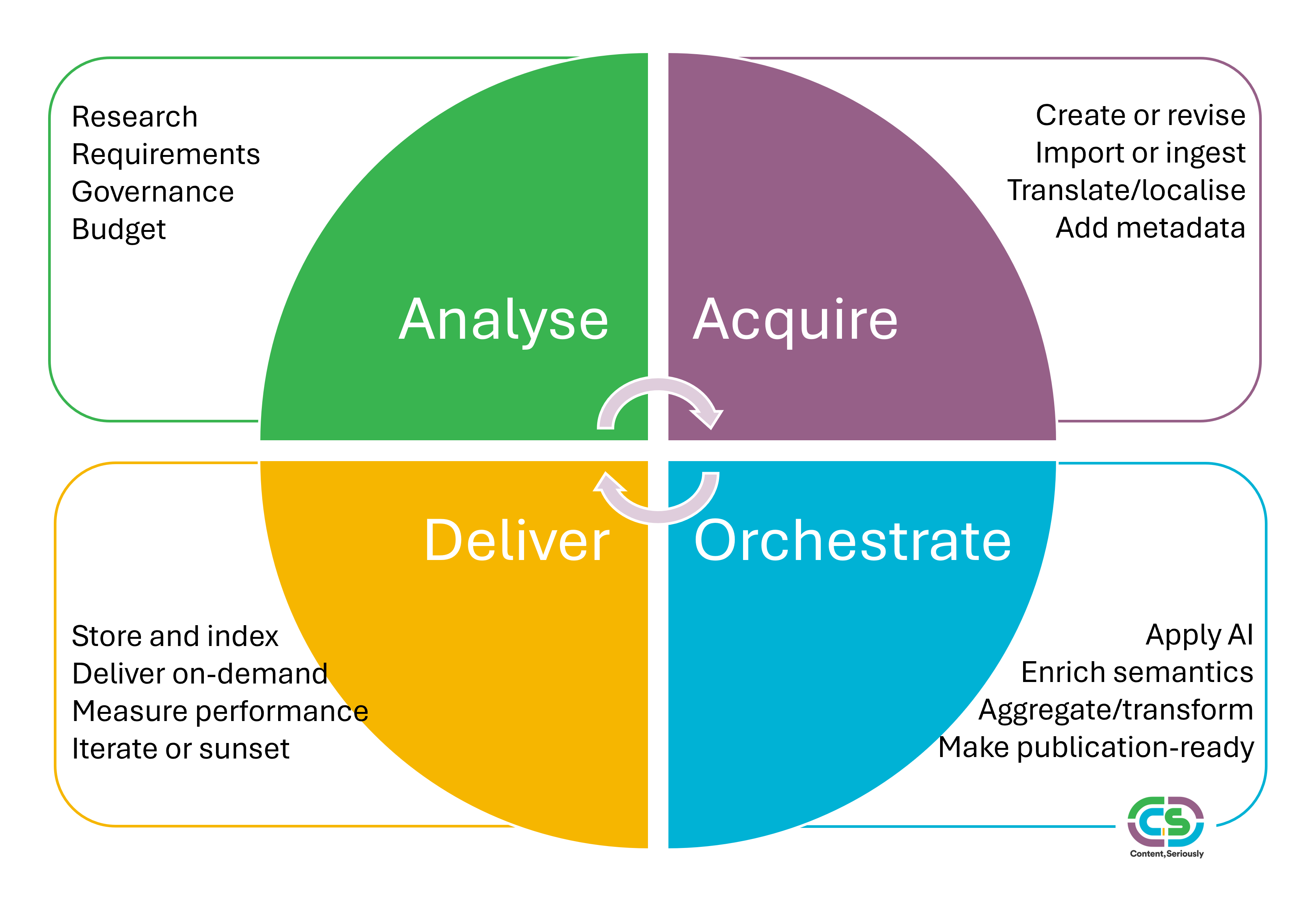
Using the analogy of constructing a house, an architect creates a blueprint that specify not only the structural dimensions, but also the heating, ventilation, and plumbing. These plans are what the builders work from. Similarly, a content strategist creates a blueprint by which designers, writers, and developers can build a successful model for delivering content. A strategist is similar to an architect in that way, designing for the system by which content producers will manage content throughout the lifecycle. There are many types of strategies for many circumstances and many content genres, trying to systemise content production for many different purposes. However, there are commonalities across the board. Much as every house has some sort of floor, roof, and entry way, every content lifecycle has four general phases:
At the beginning is the strategy phase, where you decide what type of content is needed, or whether content is needed at all, and what happens at each stage of the complete lifecycle.
Then, there is an acquisition phase, in which the content is collected, either by creating it or getting some another source. Most editorial functions falls into this phase, ensuring that content will make sense to the person ultimately consuming the content. Translations and localised content fits into this phase of the lifecycle.
The third phase is orchestration, which involves ensuring that a framework exists that allows content to become kinetic. In this phase is schema adherence, aggregation of content components, data inclusion, semantic enrichment, enhancement for AI, and a multitude of technical aspects that help content conform to pertinent rules and be processed by the tools that enable content kinesis - that is, able to respond to calls from downstream systems.
The fourth phase is delivery, where content is ready for retrieval by systems to be consumed by AI, search engines, and ultimately by people. Measurement of delivery effectiveness also determines what happens next: is it the end of the line for this content, or does the content go through the next iteration?
A content lifecycle is likely assisted or enforced through the use of technology, but it is actually conceptual. A content lifecycle governs content production, whether the lifecycle is explicit – codified knowledge used to govern adherence, or it can be implicit – a tacit understanding of how the lifecycle works and reinforced by behavioural patterns.
Lifecycle variants
While all content has a lifecycle, not all lifecycles are created equal. An organisation may have many content genres, each one with its own lifecycle. For example, marketing content works on a very different rhythm than product content. (By product content, I mean all of the content artefacts that go into the product lifecycle, such as engineering specifications, instructions for use, standard operating procedures, troubleshooting and maintenance instructions, API documentation, release notes, production descriptions and feature lists, warranties and disclaimers, subscription renewals and return policies, disposal instructions, user support content, chatbot conversations, and a host of other content that gets produced during the product lifecycle.)
Within product content, several types of content can come together, each with a different lifecycle. Content, such as a compliance disclaimer, might get used once and then be reviewed on a regular basis. Other content gets aggregated from multiple sources for presentation as an integrated unit—for example, product descriptions sent by vendors, pricing from an ERP system, and a publishing cycle with multiple dependencies, from promotional schedules to geo-boundaries. In the world of technical content, an entirely different set of tensions inform the content lifecycle. Conditional processing, re-use maps, and publishing pipelines are of paramount importance.
The introduction of generative AI has had a noticeable effect on the content lifecycle. While the wider industry is still grappling with how to use AI effectively within the content lifecycle, new twists to content lifecycles are being implemented by forward-thinking practitioners in the content space. Technical writers seem to be particularly innovative when it comes to incorporating AI into their processes, which in turn affects the overall lifecycle - mostly for the better.
The content lifecycle is the foundation of every content strategy, whether it’s for an editorial, multimodal, or technical strategy. The lifecycle affects how a content ecosystem is built to facilitate the production and delivery of content. A content lifecycle eases the process of developing a strategy and becomes the backbone that holds together the operating model for content production.