


Introduction by Heinz Wittenbrink
Dear students, dear faculty, dear management of the university. Thank you for being here, and thank you for giving me the opportunity to express my gratitude, both on behalf of the degree program and personally, to Rahel Bailie.
Dear Rahel, I want to thank you for three things:
First, for bringing a discipline into existence that takes seriously what happens to content under the changing technical and material conditions of digital civilization, together with some other, mostly female pioneers.
Second, for helping us—and me personally—to develop and implement a study program that does justice to the possibilities of this discipline.
And third, for inspiring us, both through your teaching and your publications, to maintain the openness, the willingness to take risks, and the humour that this program needs if it is to retain its academic character.
Let me start with the first of these achievements: the establishment of the discipline of content strategy. My wife Ana, whom you also know, told me yesterday: “You must tell the young people who stand up on the tram for people of your generation that you were the pioneers of the digital world, which is now taken for granted by them.”
Indeed, digital fields like content strategy initially developed on the fringes. They were often not considered serious or were seen as temporary. You were one of the people who, outside the existing hierarchies in companies and educational institutions, recognized that digitization would lead to radical—what we would now call disruptive—changes in businesses and educational institutions. You took this challenge seriously and, very early on, tried to convince companies and institutions to adapt to these changing circumstances. At the same time, you also worked to expand the knowledge base for practitioners in these new forms of communication, developing a teachable discipline through concepts and publications that we still call content strategy today.
During this pioneering period, you saw and emphasized the connection between content strategy in technical communication and organizational communication, while many others only saw one of these two fields. You also recognized the link between practice and academic discussion and publication, which is why you published at an academic level early on. As a result, your texts are cited in many later scholarly publications on content strategy. The title of your first book, Content Strategy: Connecting the dots between business, brand, and benefits, perfectly captures what characterizes your work: connecting the two sides of content strategy and bridging the gap between practice and discussable, teachable knowledge.
This almost inevitably led to content strategy being taught academically—and with that, I come to the second achievement for which we thank you today. You played a decisive role in establishing and further developing a degree program and curriculum that transformed content strategy from practical knowledge into a discipline that could be taught as a cohesive whole. Once again, you “connected the dots.”
On the one hand, you helped shape the program’s content so that the internal relationships between its various elements became understandable. On the other, you introduced the discipline as a unified field in your teaching over the years. You also played a key role in connecting us with the international content strategy community, giving us the necessary credibility in this scene. And you brought this international industry closer to the students, especially as it has developed in the English-speaking world.
A welcome side effect were excursions to London (before Brexit), where we not only got to know international companies but were also invited to your apartment on the Thames. I would like to thank you also for this today, not just in my own name.
From these personal memories, I come to the third achievement for which I want to thank you today: the spirit that drives your work and that you also inspire through your teaching and publications. It is the opposite of what a Styrian regional councilor and representative of our local Brexiters recently called a “Bollwerk Steiermark” (fortress Styria). As an academic program, we must not pull up the drawbridges; instead, we need openness, sympathy for the new and the unknown, empathy, and humor. Through your biography, you embody a cosmopolitan spirit that does not take the boundaries of nations, genders, and religions seriously, but rather the relationships between them—and the joy of crossing those boundaries and playing with these connections. Among my memories of our many meetings is one at the Tate Gallery, an institution that embodies this “wokeness” and of which you are a supporting member.
I am very pleased that today I am not only able to thank you personally for what you have done for our degree program as an academic program, but that the entire university is expressing its gratitude to you. You are the first female honorary professor at FH Joanneum, and I believe you are also the first honorary professor in the discipline of content strategy. We are all proud that you are not just a part, but an official role model of our academic community.
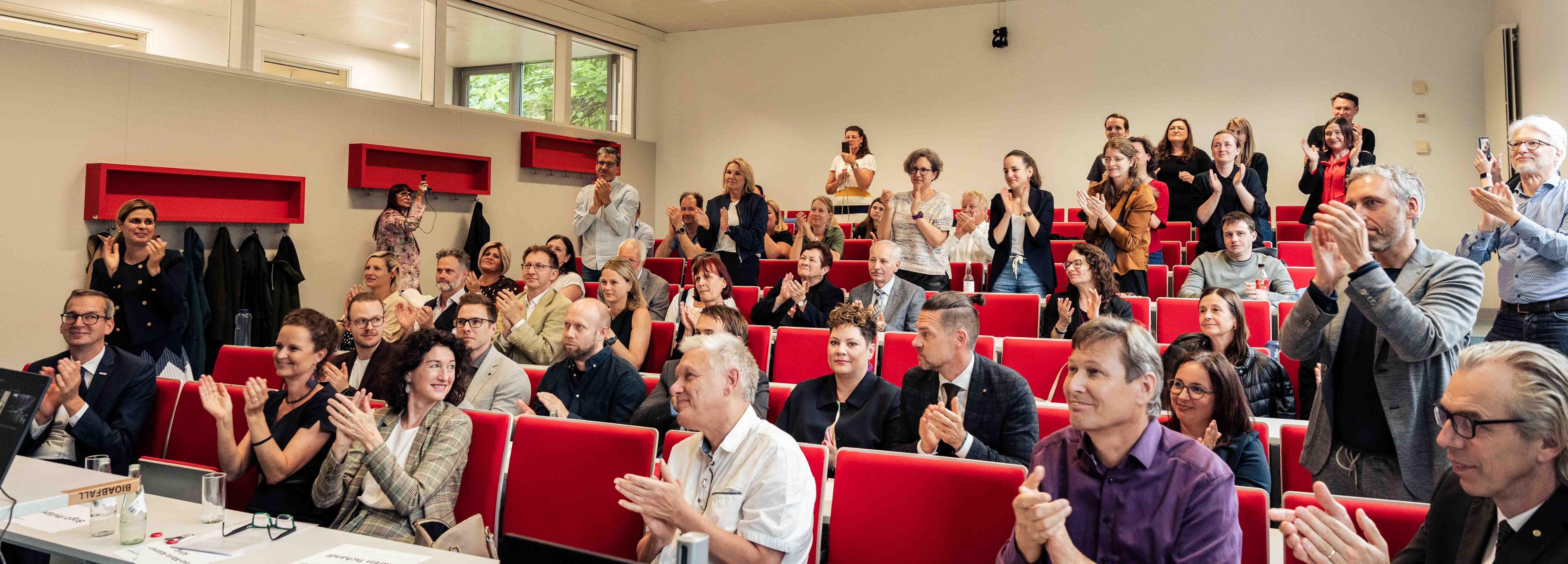
Response to Rahel Bailie presentation at the Awards Ceremony. Photo by Fabian Hasler.
Presentation by Rahel Bailie
The necklace I wear has a pendant that roughly translates to “Knowledge is Power.” But, actually, knowledge is not power without action, so taking action is very much part of my ethos. (One close friend once dubbed me “Action Grrl”.)
Taking the path of life-long learning
Education is important to me. It’s particularly important because I was raised in a household where higher education was seen as the work of the devil. Once you were educated, you were more likely to leave the church, so higher education was discouraged. So in getting an education, I was a bit of an anomaly.
Going to university was not the easiest goal to reach. I did my undergrad degree part-time at night as a mature student, while working at a minimum wage job, and single-parenting a child with multiple high-demand problems. It took 10 years, but eventually I graduated with Honours, an English degree with a major in Creative Writing and enough credits for another major in Women’s Studies, though Concordia University didn’t recognise the double major.
I used to say that I wanted to die lettered; I just had to figure out how to get my PhD while working full-time, parenting full-time, and being a contributor to society through volunteering for my professional association. The irony was that I did such a good job of being an early adopter to educate myself that by the time any program was formalised in my field of practice, I would be teaching in it rather than taking it.
Fun fact: What happens when an ADHD brain meets acute boredom while recovering from hip replacement surgery? That brain creates an entire certificate program for the University of British Columbia called Information Design and Development, a precursor to what we now call content strategy.
Getting involved with FH-Joanneum
I offer up this background to provide a little context for my involvement with the Content Strategy Master’s Degree program at FH-Joanneum. My expertise in content strategy had propelled me to what today we’d call influencer status, just in a very niche industry. (I still pay for my coffee at the local coffee shop.)
It was 2013, and I had just moved to the UK. Sascha Stoltenow, who also teaches in the program, asked me to run a workshop on content modelling at a content strategy conference in Frankfurt. Two people from FH-Joanneum, Heinz Wittenbrink and Jutta Pauschenwein, sat in the back and apologetically slipped out half-way through, saying they needed to go to another session.
I didn’t think much more about the interaction until Heinz contacted me to say that a cohort of content strategy students would be coming to London for a study week, and could I deliver a guest workshop on content audits. The student feedback was that this workshop should be the introductory course to the content strategy program, which led to Heinz asking me to develop and teach such a course. Once I had vetted the curriculum to make sure I was comfortable lending my name—I wanted to be certain that the program actually taught content strategy, unlike some other programs that paled in comparison—I gave Heinz an enthusiastic yes.
Another fun fact: For several years, I would host the students at my flat on their last day in London. I would stock my liquor cabinet, and prepare food for the meat eaters, the vegetarians, the vegans, and those with specific food allergies. We would do a debrief on highlights of the week and then chat and enjoy the view—probably the most-photographed view of London by the students. Each year’s cohort had a unique dynamic, which I truly enjoyed. It’s a tradition that lasted almost 10 years, until Brexit’s visa nonsense made it impractical, and I do miss those parties.
Watching the program mature
Those early days were chaotic and exhilarating. It is a niche community, and all of the “big names” got involved to teach in it. Heinz recruited from the German-speaking side, and I took the English-speaking side. Today, I’m still in awe at the range of expertise that is concentrated in a single program; it is impressive. The program has matured along with the industry and, as a result, retains its relevance. I don’t think the students realise how lucky they are to have these instructors at their disposal.
We went through the experimental phase, where the students were often the guinea pigs for our teaching methods. I apologise to anyone in the room from the earlier years for what we put them through. One year, the introductory course involved developing a strategy for a translation agency, which caused students some concern that they were messing with the livelihood of that company. Another year, Heinz arranged for a content strategy to be carried out across several courses, but the timing of the courses made us do things out of sequence. It took everything I had to keep it together on that one!
As the program grew, we could protect students from the chaos as much as possible, but sometimes it made for real challenges among staff. Probably the most memorable instance when Heinz came into his office, in what I’ve come to think of as his signature communication style, and said, I just realised that we don’t have a course on governance. Can you put something together and teach it tomorrow? I took a copy of Lisa Welchman’s book, Managing Chaos, back to the hotel, combined it with whatever I could find on my laptop that I had ever taught on the topic, and delivered my course the next day. That course has morphed several times since that first delivery, but the core remains intact.
What impressed me then, and still impresses me now, is the dedication of the staff. Tanja Gassler has been an anchor throughout the program. She sees all, knows all, and keeps us all on track. She has helped me from everything from finding books to getting expenses processed, from getting my Austrian pension sorted to getting my door pass to work. Leah Dvoršak was always there to help, as well as be the program historian, popping into class to take photos. Now it’s Corinna Bürger who I thank for carrying out that role, but I suspect it’s way calmer.
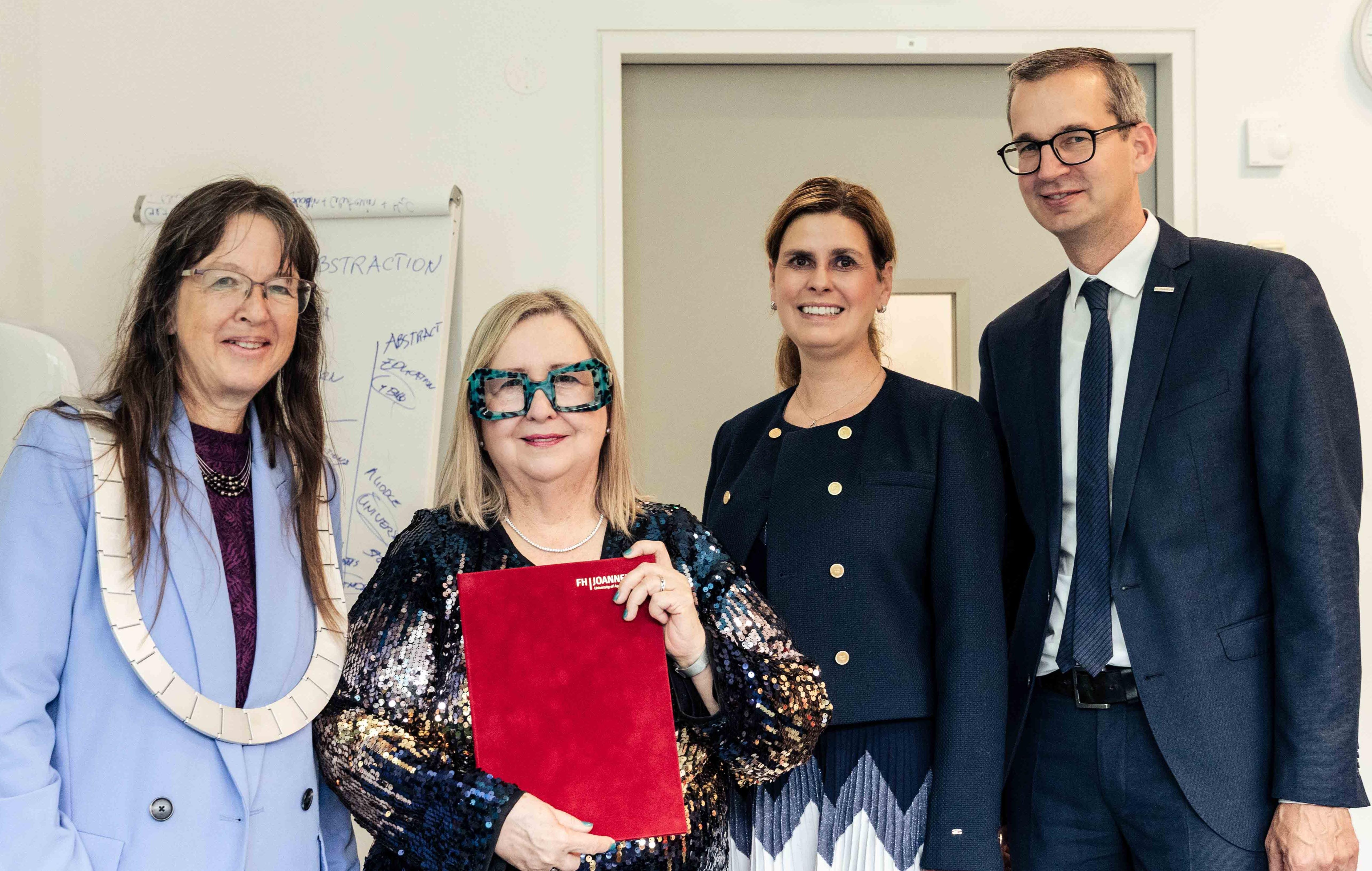
Award in hand, with Rector Corinna Engelhardt-Nowitzki, Vice-Rector and
interim Head of the Journalism and Digital Media Institute, Martina König, and CEO Martin Payer. Photo by Fabian Hasler.
Reflections on the program’s current state
When Heinz retired and Robert Gutonig took over, you could feel a definite shift. It’s like the program entered a new maturity level, with more systems in place. When Irene Michl joined the team, there was another shift as her contributions as a staff member were informed by her time in the program as a student.
It took a while to figure out who answered which questions in the new reality, but overall, Robert exuded a sense of calm consistency that signified a sense of stability. We lost some of the excitement, but gained predictability. The curriculum was updated, new instructors joined, and a new student management system was announced. The program was growing up. Of course, when I would swoop onto campus once per semester, the changes seem more subtle than when staff work on site every day. So when Robert stepped down and Heinz Fischer took over, the change did not feel jarring. We just had to get used to Robert saying “that’s a decision for Heinz, not me” but he would often mediate the discussion, so we still dealt with familiar faces.
And now the Content Strategy program enters a new phase under the direction of Martina König, who quickly got her feet under the desk, so to speak. The energy she brings is palpable, and it feels like the program has gone from infancy to youth to young adult and is finally in its proper adult phase. Of course, Martina stands on the shoulders of the many who have come before her, but I sense that the program will go far under her guidance.
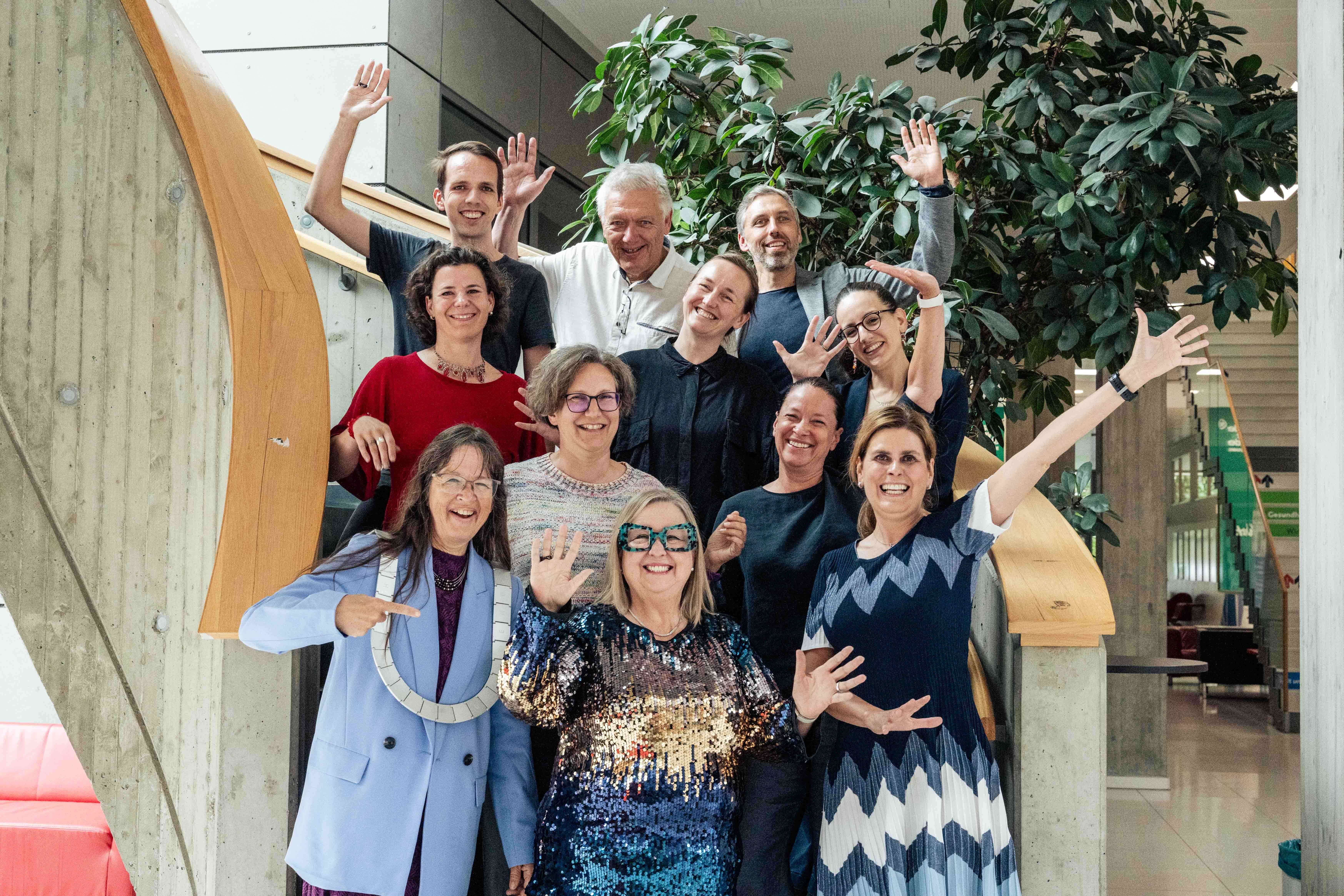
Yannik Rauter (COS25), Heinz Wittenbrink (Senior Lecturer, former Program Director), FH-Prof. Mag. Dr. Robert Gutounig (Professor, former Program Director), Anita Brunner-Irujo (COS14), Anika Kronberger (COS16), Carmen Außerhuber (COS14), Irene Michl (COS14, Senior Lecturer), Tanja Gassler (Program Coordinator), Rector Corinna Engelhardt-Nowitzki, Vice-Rector and interim Head of the Journalism and Digital Media Institute, Rahel Bailie (Hon. Prof, FH-Joanneum), Martina König. Photo by Fabian Hasler.
An ongoing alliance
So how do I fit into this new paradigm? What is my new alliance? Well, according to the Austrian pension board, I’m a bit of an anomaly; I refused to retire at the earliest opportunity. I don’t conform to what an older woman should look, or act, like, and I plan to continue contributing my expertise until I lose my relevance in the industry. I did think about retirement for a while—a very short while—but now that the university has bestowed this coveted award on me, my interest in growing along with the program has been renewed. I can’t wait to see what’s around the next corner for the Content Strategy Master’s Program.
I want to close by expressing my appreciation and gratitude to all of the people who were involved in making this happen, from Phil, my partner whose encouragement keeps me going, to my friends, Rebekah and Lydia, who travelled to share in my celebration, and of course, to students and staff in the Content Strategy program at FH-Joanneum, some who have moved on from the program, others who have joined, and those who have been with us for the duration. This is the cherry on top of a sundae of a career. It is such a great honour. Thank you.
Chatting with a few of the attendees of the awards ceremony. Video by Rebekah Roy.