


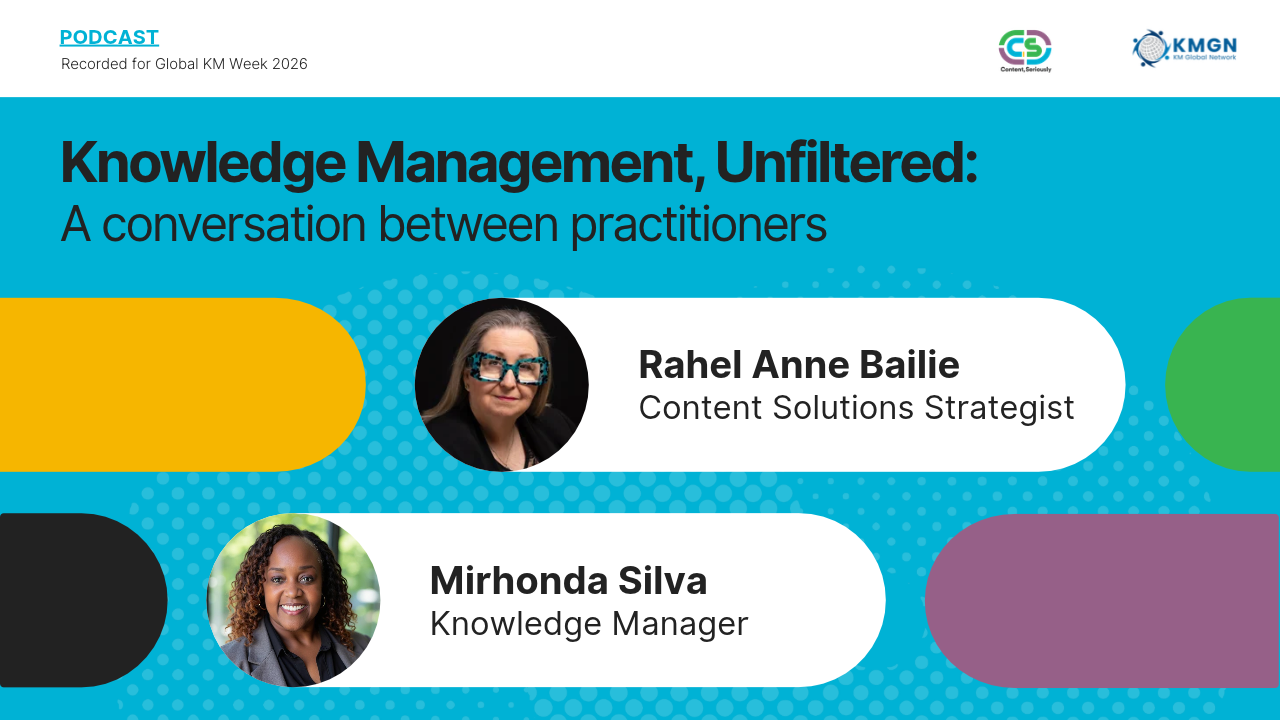
After working over than 30 years in the content industry, I am at the stage of my career where I can say everything I’ve wanted to say, without worrying about losing business over it. So I’ve launched Unfiltered, a series of frank conversations between practitioners about what they’ve actually learned in the industry.
For the first episode, recorded for Global KM Week, I talked with Mirhonda Silva, a knowledge manager who started out as a technical writer. Mirhonda describes her job as “teaching adults how to share” and being “the smoother of ruffled feathers.” She keeps a collection of toy magic wands, because that’s what people seem to think knowledge managers carry. The unfiltered series was her idea.
In our conversation, we covered a lot of ground.
What KM actually is. It isn’t a fancier word for training, content management or a piece of software. It’s about helping people make decisions and share knowledge as they work. Many people are “stealth knowledge managers” without the title.
Governance and culture. People with power but no content knowledge make the content decisions. Platforms get funded while nobody is given ownership of the content on them. I shared a stories of someone being dismissive of “just the content person.”
Documenting reality, not utopia. Mirhonda aptly pointed out that “missing” content is often fragmented, out of date or written for a happy path nobody actually takes.
Knowledge transfer and tacit knowledge. Retirees leave with “a cake and a party” and no handover. And those with tacit knowledge sometimes gatekeep in the hopes that it makes them indispensable.
Job titles don’t fit the work. “Technical writer” no longer describes the job. Often, SMEs and AI do the drafting, and the role is now about accuracy, metadata, and making content work for chatbots. i suggest that “product knowledge manager” is more accurate.
Content debt in the AI era. AI can’t fix a messy “content kitchen.” Nor can it pick the right file out of 250 versions of a sales deck. Content needs maintenance plans, a full content lifecycle and good “content hygiene.” This is where the Content Integrity Model comes in: content needs to be good quality, operationally efficient to produce, and align with strategy.
One thing to change. Mirhonda reminds us that knowledge management is a capability, not a technology. We need to treat it as a real function in the organisation and put resources behind it.